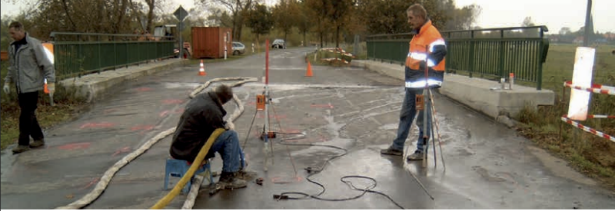
URETEK looks back on the restoration of a bridge over the Indiekkanaal near the German port town of Brake. The bridge, built in 1971, had been subsiding ever since its construction. Until 2004, the solutions had been purely cosmetic, until URETEK stepped in.
A bridge is supported on both banks by a bearing resting on a load-bearing foundation. We call this an abutment. The bridge approaches, on the other hand, usually rest on a layer of soil situated just below ground level. This asymmetrical method of foundation causes the bridge approaches to subside.
Indiekbrucke
This was also the case with the Indiekbrucke near Brake in Germany. The approach roads, supported by soft peat layers, had subsided severely. Instead of tackling the problem at its root, a ‘cosmetic’ solution was chosen: the continuous application of new layers of asphalt concrete. This only made the problem worse: the approach to the bridge became heavier and heavier. In the end, the ground had to bear the weight of 80 cm of asphalt concrete.
Breaking the vicious circle
The ‘solution’ of ever more asphalt and ever greater subsidence had to be stopped. Advice was sought from Dr Ing. Helge Bayer, an expert in the field of road construction. On his advice, the opposite approach was taken in 2004. The thick layers of asphalt were removed from the bridge approaches and the differences in height with the bridge abutment were levelled using URETEK’s FloorLift® method.
In 2015
Our German colleagues completed their work quickly in 2004, and traffic was barely disrupted during our operations. In 2015, 11 years on, the road surface elevation we installed has withstood all heavy goods traffic. The daily strain is considerable, but research shows that our material holds up perfectly.
We would not have expected anything else.