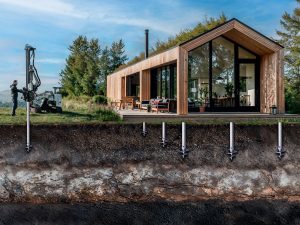
Soil investigation: a prerequisite for successful foundation repair
URETEK is recognised worldwide as a technically advanced specialist in the repair of subsided concrete floors and steel foundations.
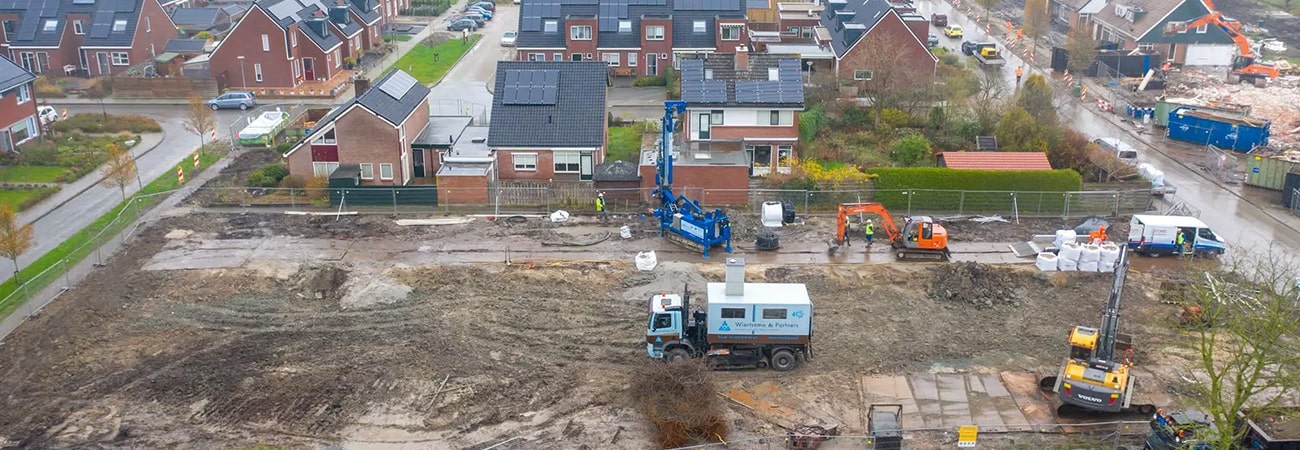
To achieve the best possible result, in addition to a thorough understanding of the foundation structure, information about the nature and composition of the subsoil is also of great importance. URETEK therefore welcomes building plans and the results of soil investigations. This enables us to determine the most suitable repair procedure.
Soil investigation reports for foundation repair
There are various techniques for investigating the mechanical properties of the subsoil. A distinction is made between the so-called ‘static penetrometer test’ and the ‘dynamic penetrometer test’.
‘Static’ means that the probe (a metal tube with a tip of standardised dimensions) is hydraulically driven into the ground at a constant speed. The resistance encountered is measured and plotted on a graph, known as the penetration curve. The dynamic test is used for harder soils.
In this test, the probe is driven into the ground using a defined weight and drop height. The number of blows per 10 cm of depth is counted and also plotted on a graph, known as the blow probe curve.
An example of a sounding curve for soil injection
These tests provide definitive information about the mechanical properties of the subsoil. To gain a good understanding of the nature of the subsoil (sand, clay, peat, etc.), the moisture content and the level of the water table, soil borings are necessary. These are used to extract soil samples. A specialist laboratory then analyses the samples and determines the nature and moisture content of the soil. For URETEK, the availability of soil reports is often a prerequisite for accepting a ground improvement contract. When it comes to soil investigation, we often collaborate with reputable geomechanical engineering firms to rule out any risks. Whilst our method is highly cost-effective, this is not the case in every situation. Our method also has its limitations.
Requirements for soil investigation
A geotechnical soil investigation provides insight into the structure of the soil layers. The soil investigation report must contain at least the following information:
– soil probing (minimum depth 10 metres) with cone resistance and friction coefficient
– borehole data (depth of at least 4 metres)
– groundwater level.
It is recommended that a sounding be carried out at at least two different locations. This allows for a better understanding of possible differences in the composition of the soil layers.
Soil investigation companies in the Netherlands
Fugro GeoServices BV
www.fugro.nl
Geonius Hoogveld BV
www.geonius.nl
Hoogveld Sonderingen BV
www.sondeerbedrijf.nl
Socotec Geotechnics BV
www.socotec.nl/diensten/geotechniek-milieuonderzoek/grondonderzoek
Mos Soil Mechanics
www.mosgeo.com
Van der Straaten Aannemingsmaatschappij BV
www.vd-straaten.nl
Tjaden Consultancy for Soil Mechanics BV
www.tjadenadvies.nl
Wiertsema & Partners – Consulting Engineers
www.wiertsema.nl
Sondertechniek – Balkbrug
www.sondeertechniek.nl
Van Dijk – Utrecht
www.vandijktech.nl
Soil investigation companies in Belgium
Samsuffit Geo Service BVBA
www.samsuffit.be
Geonius Geotechniek BV
www.geonius.nl
SGS Belgium NV
www.sgs.be
INISMa
www.inisma.be
Our unique and tried-and-tested methods
Bij URETEK zijn we trots op onze geavanceerde technieken die zorgen voor duurzame oplossingen voor verzakte en instabiele funderingen. Onze methoden zijn ontworpen om snel, efficiënt en met minimale overlast te werken, zodat uw eigendom weer veilig en stabiel is. Lees verder om meer te weten te komen over hoe onze unieke benaderingen u kunnen helpen bij het herstellen en versterken van uw funderingen.