
The dry summers of recent years have caused movement and subsidence across the country, affecting buildings, bridges, roads and railways, for example. Would you like to know what the ground conditions are like in your neighbourhood? Then take a look at the interactive ground subsidence map 2.0. Here you can see in detail which areas of the Netherlands are most severely affected by the drought. It’s ideal for determining whether your structures need to undergo further inspection and maintenance.
The ground subsidence map is an initiative of the Netherlands Centre for Geodesy and Geoinformatics (NCG), SkyGeo and Delft University of Technology, and can be viewed at bodemdalingskaart.nl. Here you can see ground movement data from more than forty billion measurement points across the country. This data has been collected using radar satellites, which re-measure the situation every few days. This makes the map both highly up-to-date and detailed: the measurements are accurate to the millimetre.
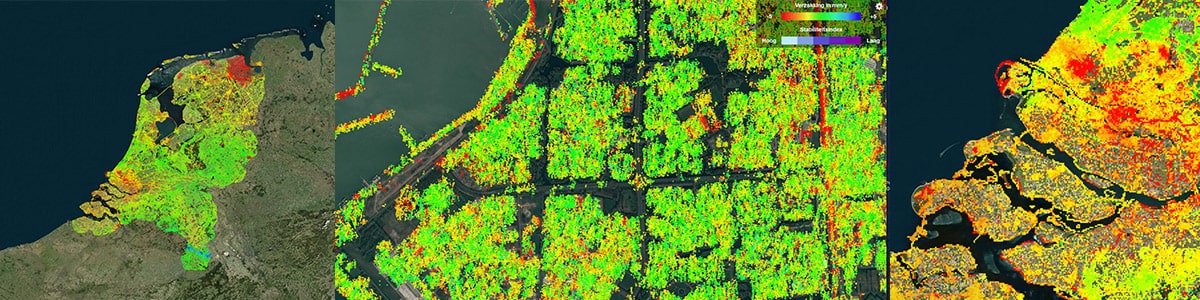 Source: Bodemdalingskaart.nl 2020
Billions in damage due to drought
Due to the drought, the ground is subsiding much faster than anticipated, causing buildings, pipes and roads, amongst other things, to sink more rapidly. The damage now runs into the tens of billions. The ground subsidence map shows that the ground in the peatlands of the western and northern Netherlands, in particular, has been subsiding more rapidly in recent years. However, sandy soils in the north and east of the country are also subsiding due to falling groundwater levels. It is therefore no luxury to monitor the condition of structures and take measures to pre-empt future problems.
Increasing foundation problems
Dick de Jong – director of the government-funded Kenniscentrum Aanpak Funderingsproblematiek (KCAF) – estimates that, over the next thirty years, one million homes alone will need to have their foundations rebuilt. According to him, this will cost an average of 80,000 euros per home. Cracks in walls and warped window frames are early warning signs of subsidence: a sign that action is needed. Whilst these warning signs were visible in around 60 Dutch municipalities until about two years ago, homeowners from 180 municipalities are now reporting foundation problems to the KCAF. That is half of the Netherlands.
A more cost-effective alternative
Fortunately, in most cases, the costly installation of a completely new foundation is not necessary, and the URETEK DeepInjection® method offers a solution. This involves injecting a powerful expansion resin directly beneath the foundation, which resolves the problems quickly and quite simply. Often within just one or two days, and without having to clear out the property. The expansion resin strengthens the subsoil, restores and stabilises the foundation, and prevents further subsidence. Precise, durable, environmentally friendly and without any digging or demolition work.
Read more about the URETEK method and the experiences of homeowners who have chosen this method.
Read more and take a look for yourself at the ground subsidence map on bodemdalingskaart.nl
Sources:
Delft University of Technology:
https://www.tudelft.nl/2020/tu-delft/nieuwe-bodemdalingskaart-toont-de-instabiliteit-van-nederland/
Volkskrant:
- https://www.volkskrant.nl/nieuws-achtergrond/huizen-verzakken-sneller-door-droogte-schade-loopt-in-de-tientallen-miljarden~b9e59bc3/
- https://www.volkskrant.nl/nieuws-achtergrond/haar-huis-werd-een-hellingbaan-stedenbouwkundige-riek-bakker-weet-wat-bodemdaling-doet~b0062893/
- https://www.volkskrant.nl/nieuws-achtergrond/waarom-doet-het-rijk-zo-weinig-aan-bodemdaling-en-co2-uitstoot-in-veenweidegebieden~bdc5ab90/
NOS: